Design RAG Over 10M Docs, Zero Hallucinations

Raunak Baliyan
23 October 2026 · 20 min read
System Design · AI Architecture
Design RAG Over 10M Docs, Zero Hallucinations
How would you build a Retrieval-Augmented Generation (RAG) system that searches 10 million documents, delivers low-latency answers, and grounds every factual claim in verifiable source evidence?
The Challenge
Building RAG at production scale requires more than embeddings and an LLM. The system must retrieve relevant passages, preserve source citations, handle document updates and deletions, and reject unsupported claims—all while meeting strict latency and availability targets.
What You'll Learn
- Scalable ingestion: Process millions of documents through asynchronous Kafka-driven pipelines, chunking, embeddings, and parallel indexing.
- Hybrid retrieval: Combine Qdrant vector search and Elasticsearch BM25 using Reciprocal Rank Fusion (RRF).
- Precision reranking: Use a cross-encoder to select the most relevant passages and expand context when necessary.
- Grounded generation: Require inline citations and validate generated claims against retrieved source passages.
- Freshness and caching: Invalidate cached answers and prevent outdated document versions from appearing in new responses.
Architecture at a Glance
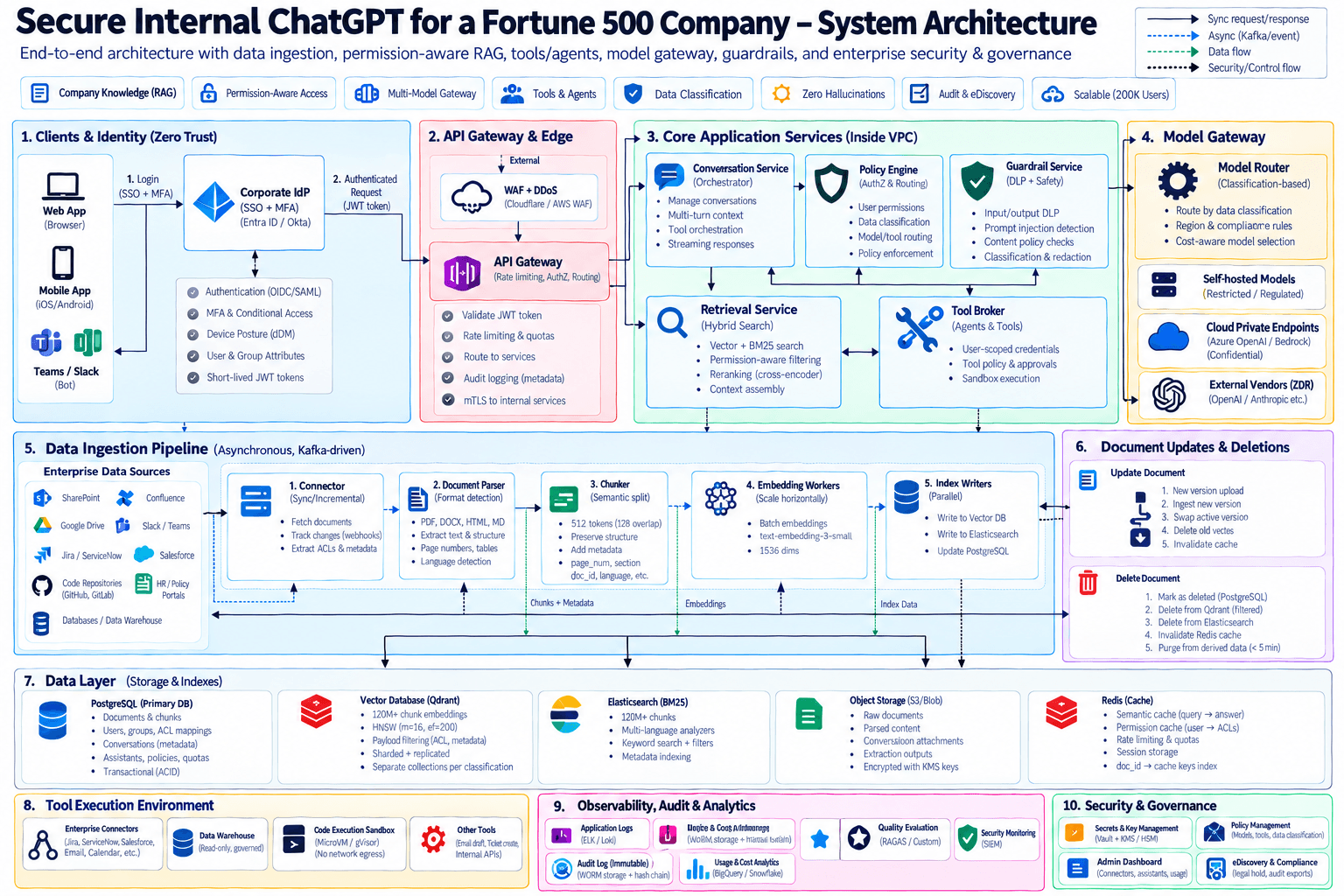
The design combines Kafka, PostgreSQL, Qdrant, Elasticsearch, Redis, and an LLM inference layer. Independent ingestion and query pipelines allow the system to scale workloads separately, while citation verification and faithfulness checks help detect unsupported claims.
Key Takeaway
Reliable RAG depends on the entire retrieval and verification pipeline—not just the language model. Strong retrieval, source-level citations, document lifecycle controls, and independent validation are essential for trustworthy answers at scale.
Sign in to continue reading
Sign in with Google to read the complete free article.
This public preview is available to everyone.